
Quds Force (2)
#11753 · Alternative
#14713 · Iran
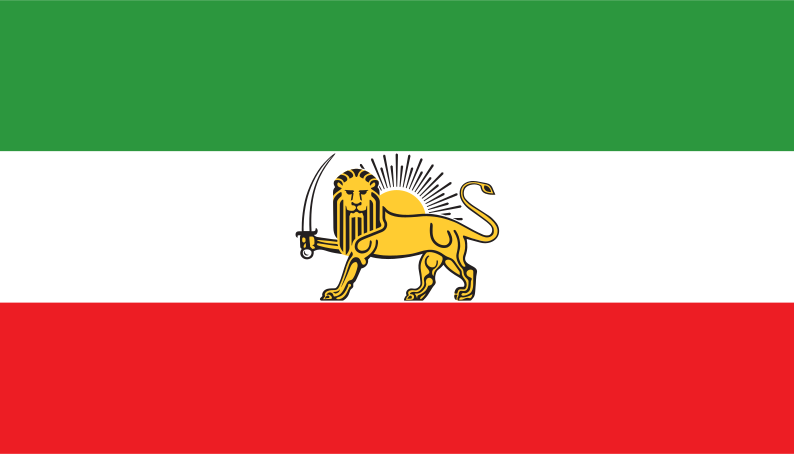
Proposal for a Standardized Lion and Sun Flag for Iran A cultural design project by Faraz Farsiani with guidance from Shabnam Mirhadizadeh There is currently no widely accepted, historically grounded standard for the design of the Iranian Lion and Sun flag, and many used are informally designed or digitally improvised, some of the most popular by non-Iranians which use European heraldry styles rather than Iranian art philosophy. We feel this has led to a fragmentation of Iran’s national symbol rather than unity, which should be its primary purpose. We have incorporated design elements of the historical description of the Lion and Sun symbol, primarily based on the Pahlavi government’s standardized design adopted in 1973, with changes meant to modernize the flag and make it more accessible and aesthetically pleasing. Rationale for the selection of reference This project looks at a multitude of historical and contemporary renditions of the Lion and Sun emblem with the objective of identifying the ideal reference for the modern redesign of the symbol. We have done this based on the principles of symbol design, visual clarity, scalability, and reproducibility. The first design we considered was the official Iranian state flag used between 1973 and 1979, which was ultimately chosen as the primary reference. This version reflects the both forward thinking and traditional mindset of the Pahlavi government; it is the only formally standardized, state-approved configuration of the national flag adopted in Iran’s history. It strikes a deliberate balance between symbolic expression, evident by the use of traditional design patterns dating back to the Achaemenid empire, and structural simplicity. It uses proportional relationships and line weights, with controlled detail distribution ensuring legibility across a wide range of scales and applications. 1973 Standard, the Base Inspiration for the Design This is a great design; we have only tweaked the facial features for a more regal and serious look and simplified the line art on the legs to make it less cluttered while keeping the same aesthetic. We have also removed the pedestal and shortened the sword to allow room for a larger, more visible symbol. Our project uses this flag as our base model and reference. While preserving the historical identity masterfully proposed by it, we have refined the Lion’s facial structure, with all contours being redrawn with standard line weights that are consistent with contemporary symbol design practice. This was done to improve visual coherence and enhance clarity of the visual’s symbolic significance. We believe a Lion should be proud, stern, and powerful, and the old symbol did not properly convey that energy. We assessed that the other popular versions commonly used by the Iranian opposition were unsuitable for use as functional symbols. These versions, designed by Wikipedia user Sodacan in 2012, rely on excessive ornamental detail which results in visual noise and lack of a clear hierarchy. In several areas, line weights are reduced to a level that compromises visibility particularly at smaller scales or technical output such as printing or engraving. This makes them more effective as illustrative artwork rather than scalable symbolic representation. The second design is also too cartoonish and vague. Both designs, while good on their own merit, reflect the designs of European heraldry rather than traditional Iranian design patterns. Modern Versions Designed on Wikipedia These designs of the Lion reflect a rendition of European heraldry rather than Iranian ones. While the designs are popular and digitally replicable, they are not appropriate for an Iranian national symbol. Typical Features of the Flag and Symbol Tricolour – the classic colours of green, representing nature and growth; white, representing peace and purity; red, representing courage and heroism; all of these pillars of Iranian civilization. These were kept unchanged, using these standard hexadecimal colour codes: Green: #2C973E White: #FFFFF Red: #ED1D24 The colour of the symbol has been slightly altered to a more golden yellow for more cohesion, with a blackish grey outline: Golden Yellow: #FFCC31 Blackish Grey: #231F20 Pedestal and Sword – the pedestal is a recent addition to the flag, this was not present in most of the history of the symbol, dating back to its usage on the flag since the Qajar era. We felt this was unnecessary, as the lion can be understood to be standing on the red stripe, meaning no pedestal is needed. We have removed the pedestal to make room for the lion to be larger, making it more visible and prominent. Additionally, we have also shortened the length of the sword (which is in the design of a native Iranian blade, called a "Shamshir" in English) for the same purpose of allowing more room for a larger central symbol. Lion’s body and legs – the pattern reflects the relief stone carvings found on ancient Iranian sites, most notably Persepolis (Parsa or Takht-e-Jamshid), with sharply defined curves and ridges. This design is taken from the 1973 standardized version, albeit the design has been simplified (some lines removed) to make it more visible at a distance and less cluttered. Lion’s face – The original 1973 rendition gives the Lion a very whimsical and cartoonish look. We have decided to give the Lion a more stern, powerful expression and facial structure, to reflect Iran’s strength and sovereignty, while retaining its anthropomorphic properties visible on the symbol’s history. This more modern and streamlined aesthetic aligns with the Lion’s symbolism as a powerful protector, while being clear enough for digital and physical readability. A relief carving depicting a Lion, as seen on the walls of Persepolis. The body, particularly the legs, reflect the design visible on the Lion and Sun symbol Construction Sheet This project is an effort to re-contextualize a historical emblem through contemporary design logic, maintaining respect for its cultural origin while aligning it with current visual and technical standards. We hope that this project’s design will serve as a possible inspiration for the future of Iran’s flag once it becomes a free nation. Contact: Email: farazfarsiani@gmail.com
#11753 · Alternative
#11865 · Syrian Civil War Flag
#11752 · Gaza war
#11755 · Armed Forces of Iran
#11754 · Gaza war
#11877 · Military
#11880 · Iran